Key facts
- Hearing loss in children can range from mild to severe and can be temporary or permanent.
- Hearing loss can be caused by different things, including genetics, infections, an injury or wax build-up.
- Early diagnosis and treatment of hearing loss is important to help your child develop their communication skills.
In This Article
- Understanding childhood hearing impairment
- Different forms of hearing impairment
- Common causes of hearing difficulties
- Detecting hearing problems early
- Assessing your child’s hearing
- Treatment and intervention options
- Preventing hearing damage
- Potential impacts of untreated hearing loss
- Tools And Assistance
Understanding childhood hearing impairment
Hearing loss can affect babies and children and means that your child has lost some or all of their hearing in one or both ears.
It can be temporary (lasting a short time) or permanent.
Hearing loss in only one ear is called unilateral hearing loss.
Hearing loss is described by:
how much hearing has been lost (mild, moderate, severe, or profound)
which part of the ear is affected
Severe or profound hearing loss is known as deafness.
Different forms of hearing impairment
The outer and middle ear send soundwaves to the inner ear. In the inner ear, sounds are converted to nerve signals, which are sent to the brain.
The type of hearing loss depends on which part of the ear is affected.
The different parts of the ear are:
- outer ear (ear canal and pinna)
- middle ear (eardrum, ear bones, and eustachian tube)
- inner ear (cochlear and hearing nerve)
There are 3 types of hearing loss:
- conductive hearing loss
- sensorineural hearing loss
- mixed hearing loss
Conductive hearing loss
Conductive hearing loss happens when there is a problem with the outer or middle parts of the ear, preventing soundwaves from reaching the inner ear properly.
Conductive hearing loss is usually temporary.
Sensorineural hearing loss
Sensorineural hearing loss is caused by a problem in the inner ear or with the auditory nerve.
It is usually permanent.
Mixed hearing loss
Mixed hearing loss involves both conductive and sensorineural hearing loss.
Common causes of hearing difficulties
Causes of conductive hearing loss
Temporary conductive hearing loss can be caused by:
- Wax blockage
- Middle ear infection (otitis media)
- Fluid build-up in the middle ear
Conductive hearing loss may be permanent if the ear bones or ear canal are:
- Damaged
- Incorrectly formed
Ear infections are common in babies and young children. Most ear infections will go away without treatment in 2 to 3 days. After this time, you should see a doctor.
Causes of sensorineural hearing loss
Sensorineural hearing loss can be caused by:
- A problem with the development of the inner ear
- A physical injury to the head or inner ear
- Damage to the ear from a disease such as meningitis
- Excessive exposure to loud noise
Problems with the inner ear can also be caused by:
- Genetics
- An infection during pregnancy, like rubella
- Problems due to preterm birth
Sensorineural hearing loss is usually permanent.
Detecting hearing problems early
Your child may have hearing loss if they don’t meet some of their milestones, which include:
- Reacting to loud noises by 3 months of age
- Noticing when you speak by 3 months
- Turning to where sounds are coming from and babbling by 6 to 12 months
- Responding to their name by 6 to 18 months
- Being able to speak simple words and follow simple instructions by 12 to 24 months
Other possible signs of hearing loss include:
- Hearing some sounds but not others
- Appearing inattentive
If you think your child might be experiencing hearing loss, you should visit your doctor.
Assessing your child’s hearing
If you suspect your child has hearing loss, you can take them to your doctor. The doctor will examine your child to diagnose the type and extent of the hearing loss.
Babies and children with possible hearing loss can be referred to specialists, such as:
- An audiologist — a health professional who provides advice, education, and treatment for hearing problems
- A paediatrician (children’s doctor)
- An ear, nose, and throat specialist
Treatment and intervention options
Hearing technology
You may choose to use technologies to assist your child’s hearing, including:
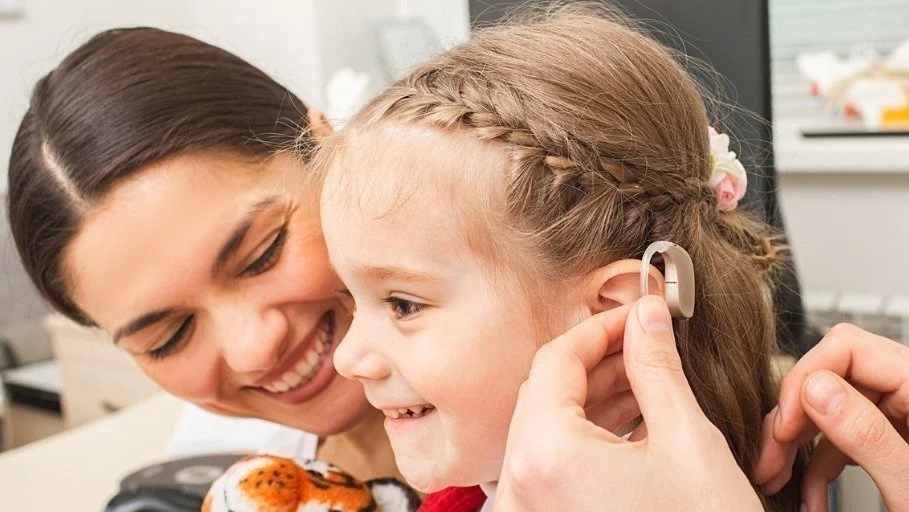
- Hearing aids, or other technology to amplify sounds or assist hearing
- A cochlear implant for severe or profound hearing loss
Early intervention
Early communication is crucial for your child’s development. Your child may benefit from speech therapy.
If your child has hearing loss, they can communicate in various ways, including:
- Spoken language
- Sign language
- A combination of sign and spoken language
Assistance from a specialist teacher of the deaf can help make the most of any residual hearing.
Other treatments
Other treatments for hearing loss may include:
- Removal of a foreign object or wax
- Medications like antibiotics for ear infections
- Grommets (tubes that help drain fluid from the ear) may be recommended for repeated ear infections
Regular check-ups
Children with hearing loss need regular developmental monitoring, including:
- Hearing tests
- Eye examinations
- Appointments with a paediatrician
Recognizing your child’s hearing loss early can help you adjust to their needs and support them in connecting with the world around them.
Preventing hearing damage
You can help prevent hearing loss by:
- Protecting your child’s ears from infection and loud noises
- Vaccinating your child against:
- Rubella
- Measles
- Mumps
- Meningitis
Breastfeeding can also help fight infections.
If your child gets an ear infection, treat it as soon as possible to prevent hearing loss.
Teach your child good hygiene to prevent infections, and help them eat healthily to support their immune system.
Ear protection
Make sure your child interacts with screens and music at a safe volume.
Use ear protection, like earmuffs, around loud noises such as:
- Concerts
- Sporting events
- Fireworks
- Power tools
Take care of your own hearing as a role model for your child. If your child is in a loud space, teach them that they can move to where their ears are comfortable.
Potential impacts of untreated hearing loss
Hearing loss can delay your child’s speech development.
Problems with the inner ear can sometimes cause issues with balance.
Diagnosing hearing loss early reduces the risk of developmental delays.
Tools and assistance
Online support for parents of children with hearing loss is available. Some useful resources include:
- Hearing Awareness: Websites, forums, and support groups for parents of children with hearing loss.
- Audiologists: Professionals who can provide customized hearing aids or cochlear implants, and recommend early intervention strategies.
- Speech Therapy: Access to speech therapists who specialize in helping children with hearing impairments develop language skills.
- Parenting Resources: Educational materials and workshops to assist parents in understanding and managing hearing loss in children.
- Educational Support: Assistance from specialized teachers of the deaf to help your child with communication and integration into learning environments.










Please log in to leave a comment.