Highlights
- It’s best to cut your baby’s nails if they are longer than the tips of their fingers.
- Your baby may scratch themselves if their nails are too long or sharp.
- Hold your baby’s hand or foot firmly and gently pull the pad of their finger or toe away from the nail.
- Cut the nail straight across using baby nail clippers or scissors.
- It’s best not to bite or peel your baby’s nails.
In This Article
- When is it necessary to cut my baby’s nails?
- Possible consequences of not trimming your baby’s nails
- Proper technique for cutting your baby’s nails
- A step-by-step guide for safe nail cutting
- Key mistakes to avoid while trimming nails
- What to do if something goes wrong
When is it necessary to cut my baby’s nails?
It’s best to cut your baby’s nails if they are longer than the tips of their fingers. You may not need to cut your baby’s nails for the first few months. Some babies are born with longer nails than others, and some babies’ nails grow faster than others. You may feel a little uneasy when you first cut your baby’s tiny nails, but as your baby grows, you will be able to take care of their nails with confidence.
Possible consequences of not trimming your baby’s nails
Young babies can’t control their arm or leg movements. If their nails are too long, sharp, or jagged, they may scratch themselves. If it’s hard to stop your baby from scratching themselves, you can put mittens on their hands. However, as your baby grows, it’s best to have mittens off while they’re awake so they can learn to use their hands.
Proper technique for cutting your baby’s nails
The best time to cut your baby’s nails is when they’re asleep or very drowsy and calm. After a bath is a good time because their nails will be softer. Make sure you have plenty of light and that you hold your baby on your lap or on a flat surface. Hold their hand or foot firmly so they don’t move. It can help if someone else holds the baby while you cut the nails.
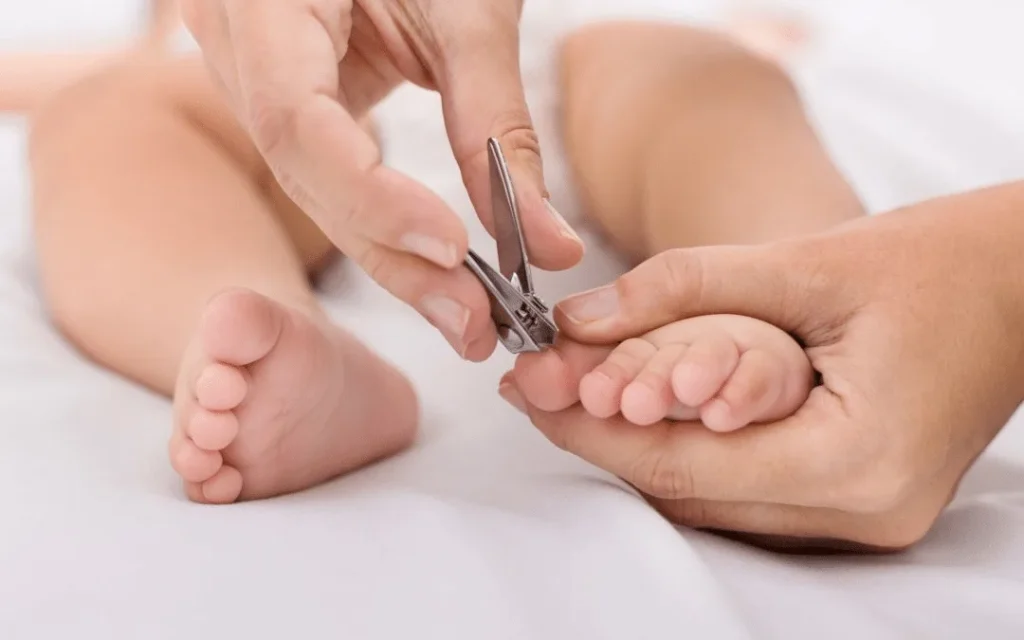
You can use baby nail clippers or baby nail scissors with rounded ends. Do not use adult nail clippers. Pull the pad of the finger or toe gently away from the nail to avoid cutting your baby’s skin and then cut the nail straight across.
Sometimes you may just need to use an emery board (nail file) to smooth and round the nail.
A step-by-step guide for safe nail cutting
Follow these steps to cut your baby’s nails safely:
- Hold your baby on your lap or a flat surface.
- Work in an area where there is plenty of light.
- Firmly hold your baby’s hand or foot, then hold each finger or toe in turn as you cut each nail.
- Gently pull the skin of the fingertip or toe away from the nail.
- Use baby nail clippers or rounded baby nail scissors and cut the nail straight across.
- Smooth the nail with an emery board (nail file) if there are any sharp edges.
Key mistakes to avoid while trimming nails
It’s not a good idea to bite your baby’s nails with your teeth, because this can spread germs from your mouth and lead to an infection. It’s best not to peel your baby’s nails. You could easily tear them back too far, which will hurt your baby. Try not to shape the nail or cut down the sides of the nail. This can cause ingrown nails and infections.
What to do if something goes wrong
If it doesn’t get better, take your baby to the doctor. They may need antibiotics. If it’s bleeding, gently press a soft, clean cloth over the cut until the bleeding stops. Don’t put on a dressing like a band-aid, as your baby might suck on it and it could come off. If the skin next to your baby’s nail is red, swollen, or painful, they may have an infection. If this happens, you can soak their finger or toe in warm water and apply some antiseptic cream to keep the area clean.
Tools and Assistance
There are several tools and techniques available to help you safely trim your baby’s nails:
- Baby Nail Clippers or Scissors
These tools are specifically designed for infants and have rounded tips to prevent injury. They are smaller and gentler on tiny nails. Always use tools designed for babies rather than adult clippers to ensure safety. - Nail File (Emery Board)
An emery board can be used to smooth out any sharp edges after cutting your baby’s nails. This can help prevent scratching. Use one that is soft and gentle for babies’ sensitive nails. - Mittens or Scratch Sleeves
If your baby has long nails and you’re waiting for the right moment to trim them, mittens or scratch sleeves can help prevent scratching. They are especially useful in the first few months when babies are most likely to scratch themselves. - Good Lighting
Ensure that you are trimming your baby’s nails in an area with good lighting. This will allow you to see clearly and make the process easier and safer. - Comfortable Positioning
It’s helpful to keep your baby calm and comfortable during the nail cutting process. Holding your baby on your lap or placing them on a soft, flat surface ensures they are stable, making it easier to trim their nails. - Soothing Techniques
If your baby is upset, consider soothing them with gentle movements, speaking softly, or playing a calm song. Keeping them relaxed can make the process smoother. - Backup Support
If you are feeling nervous about cutting your baby’s nails, having another adult hold the baby or assist can help make the process easier. - Antiseptic Cream
In case of a small nick or cut, an antiseptic cream can be helpful to prevent any infection. Always check the skin around the nails after cutting to ensure no irritation has occurred.











Please log in to leave a comment.