Highlights
- The newborn bloodspot test screens for rare disorders that are more treatable if detected early.
- The test is performed within the first 48 to 72 hours after birth.
- The test is free and requires parental consent.
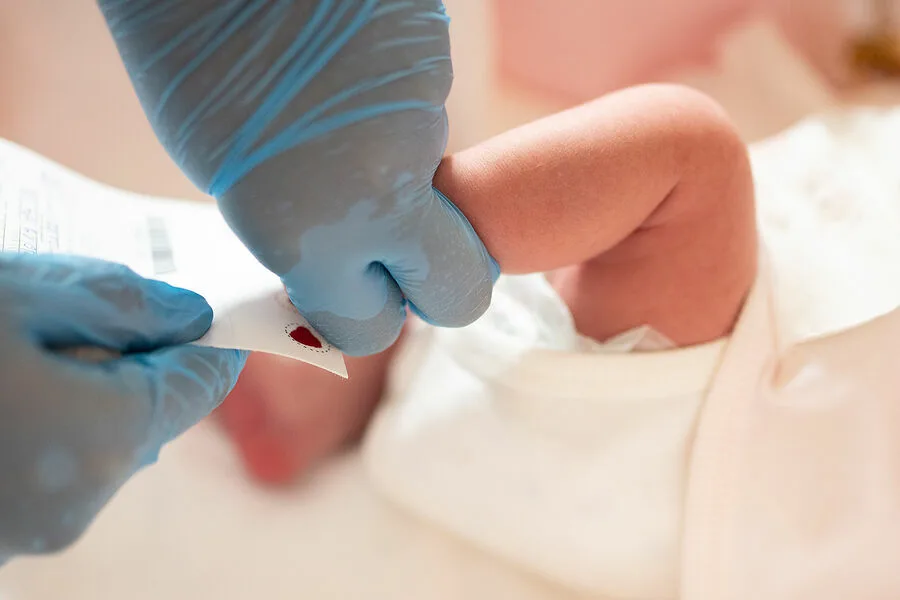
- The test involves pricking your baby’s heel to collect blood on a special filter paper.
- Most babies will have normal results, and parents will only be contacted if there are concerns.
In This Article
- Overview of the newborn bloodspot screening test
- Procedure for the test
- Conditions being screened for
- Understanding the results
- Sample storage and usage
- Parental consent for newborn screening
- Tools and Support
Overview of the newborn bloodspot screening test
The newborn bloodspot screening test is a quick procedure to detect several rare disorders that are easier to treat if found early. It is done within 48 to 72 hours of birth and is commonly known as the “heel prick” test.
- It is offered to all parents and is voluntary.
- Parental consent is required.
- Most babies tested will have normal results.
- Parents will be contacted only if concerns arise.
Procedure for the test
If parents agree, a nurse or midwife will prick the baby’s heel using a thin needle and collect a few drops of blood on a special filter paper.
- The heel prick is brief but may be uncomfortable.
- Holding or breastfeeding the baby can reduce the discomfort.
- The blood sample is sent to a laboratory for testing.
Conditions being screened for
The newborn bloodspot screening test checks for several rare but serious conditions. Early detection helps ensure timely intervention and can prevent severe health issues or death.
Understanding the results
- Most babies will have normal results.
- Parents will be contacted if there are concerns with the test results.
- If the first test is unclear, a second test may be needed, which typically also returns normal results.
- If a positive result is returned, further tests will confirm the diagnosis, and treatment will begin promptly.
What is being screened for?
Newborn bloodspot screening helps to identify a range of conditions, including these:
Congenital hypothyroidism
| How common? | 1 in 2,200 |
| Causes | Thyroid gland does not produce thyroid hormones (T3 and T4 hormones) |
| Risks if untreated | Poor growth, intellectual disability |
| Treatment and management | Thyroid hormone supplements |
Amino acid disorders e.g. phenylketonuria (PKU)
| How common? | 1 in 12,000 |
| Causes | Problems with the enzymes that break down protein |
| Risks if untreated | Developmental delay, intellectual disability seizures |
| Treatment and management | Dietary changes, vitamin supplements |
Congenital adrenal hyperplasia (CAH)
| How common? | 1 in 15,000 |
| Causes | Problems with the enzymes that help balance sugar and salt |
| Risks if untreated | Increased male sex hormones, loss of water and salt in the urine, risk of sudden death |
| Treatment and management | Adrenal hormone supplements |
Cystic fibrosis
| How common? | 1 in 3,300 |
| Causes | Abnormal secretions in the body, for example thick and sticky mucus in the lungs and problems with the digestive system |
| Risks if untreated | Problems with digestive and lung functions, infections and a shorter lifespan. |
| Treatment and management | Dietary supplements, physiotherapy |
Fatty acid oxidation disorders
| How common? | 1 in 12,000 |
| Causes | Problems with the enzymes that turn fat into energy |
| Risks if untreated | Low blood sugar especially when fasting, muscle and heart problems |
| Treatment and management | Avoid prolonged fasting, get advice on dietary modifications |
Sample storage and usage
- The collected samples are securely stored for quality control.
- Samples are kept in a locked location until the child reaches 18 years old.
- In some cases, the sample card can be returned to the parents after two years.
- Once identifying information is removed, the samples may be used for research or further testing at the parent’s request.
- After a specific period, the samples are destroyed.
Parental consent for newborn screening
Newborn screening is entirely voluntary.
- Newborn screening tests are free of charge.
- Parents have the option to decide whether they want the test performed.
- Doctors will explain the benefits and risks, enabling parents to make an informed decision.
Tools and Support
- Healthcare Providers: Consult your primary healthcare provider for information on the newborn bloodspot screening test and any follow-up actions needed.
- Local Health Clinics and Hospitals: For additional resources or specialists, contact your local clinic or hospital.
- Parent Support Groups: Connect with groups for emotional support and practical advice if your baby’s screening result is concerning.
- Genetic Counseling: If a condition is detected, genetic counseling can help you understand the diagnosis and implications for future pregnancies.
- Online Resources: Health organizations provide online resources to explain the screened conditions in more detail.
- Follow-up Testing: If results suggest a health concern, follow-up tests are necessary, and your healthcare provider will guide you through the process.
- Mental Health Support: If needed, mental health professionals can provide support for coping with emotional distress after receiving test results.












Please log in to leave a comment.